

Complete Guide to Maa Jainteshwari, Kamadishwar Bhairava, History, Sadhana, Puranic Tradition, Durga Puja and How to Reach
Hari Om. Jai Maa Jayanti. Jai Maa Nartiang Durga.
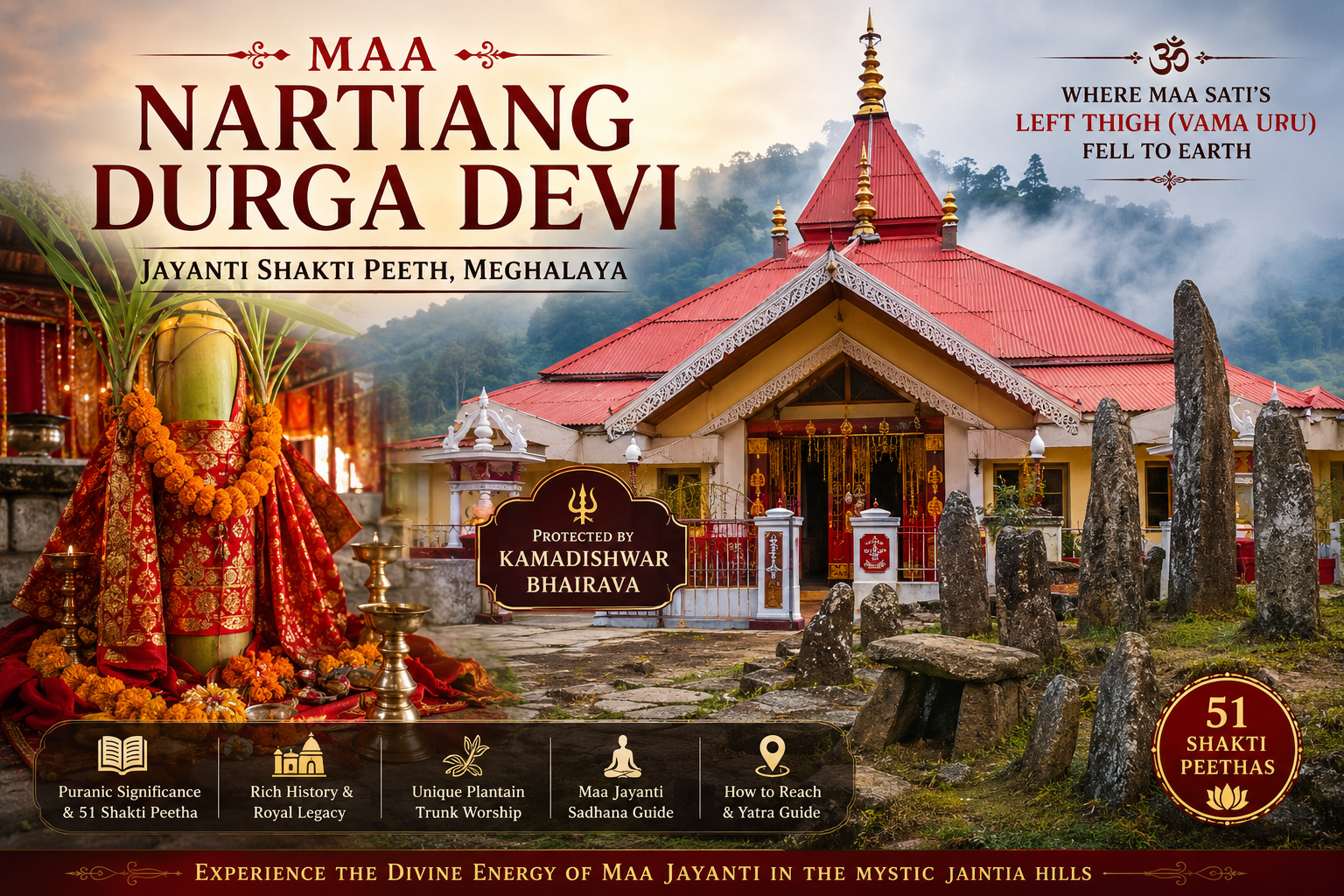
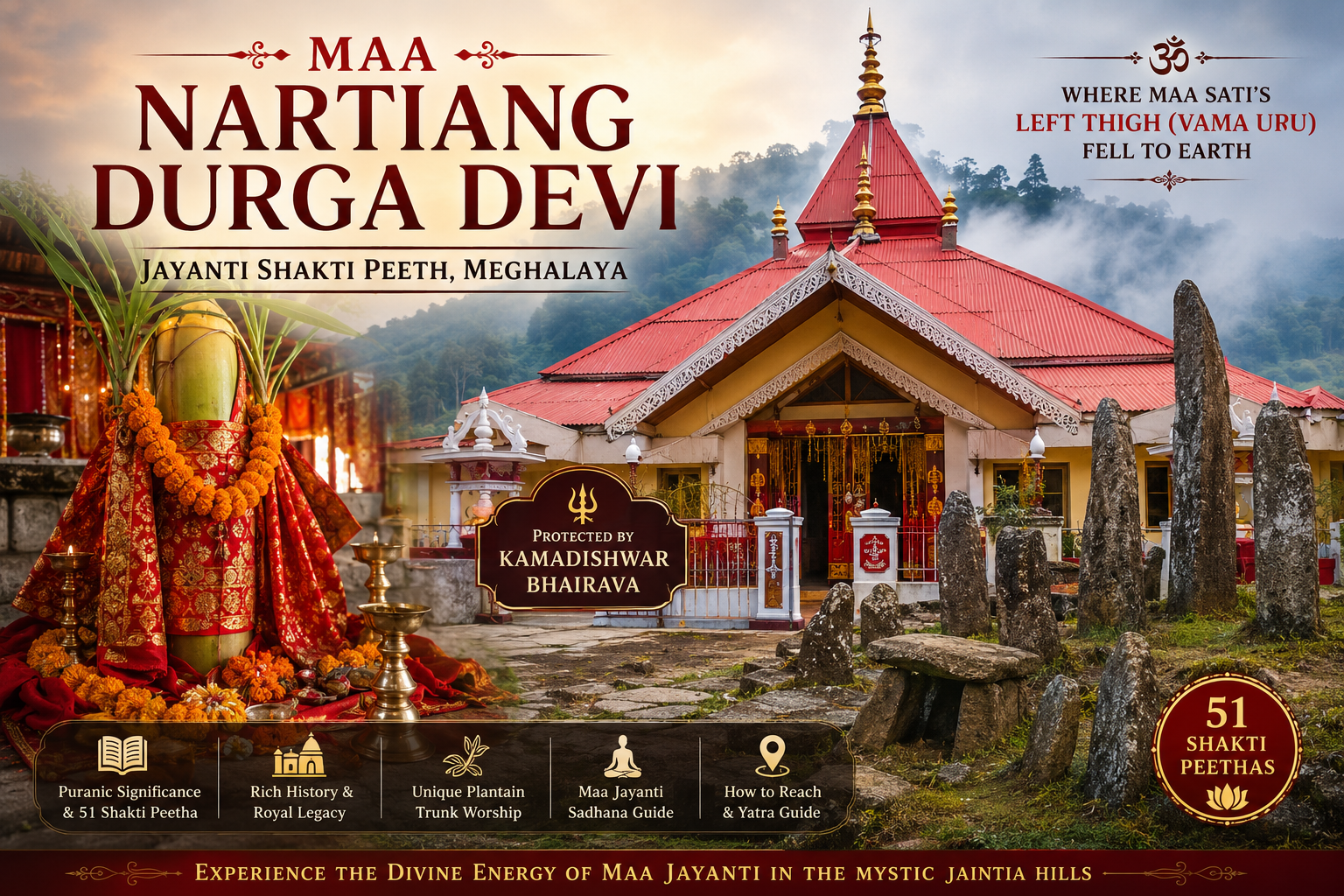
Hidden within the rain-washed, mist-covered sacred landscape of Meghalaya's Jaintia Hills stands one of the most mysterious and spiritually powerful abodes of the Divine Mother—Nartiang Durga Temple, revered by Shakta devotees as the sacred Jayanti Shakti Peeth.
This is not merely a temple.
For a sincere Devi Upasaka, Nartiang is an encounter with a living current of Adi Parashakti—a place where ancient Shakta traditions, royal history, indigenous Pnar-Jaintia customs, Tantra, Durga worship and the timeless mythology of Maa Sati appear to converge.
The Mother worshipped here is known by several sacred names:
- Maa Jayanti
- Maa Jainteshwari
- Nartiang Durga Devi
- Jayanti Shakti
According to the sacred Shakta tradition of the 51 Shakti Peethas, this is the place where the left thigh—Vama Uru—of Maa Sati is believed to have fallen.
Her eternal guardian and Bhairava at this Peeth is traditionally identified as:
Sri Kamadishwar Bhairava
also written in some traditions as Kramadishwar Bhairava.
To understand Nartiang is to understand something profound: the Divine Mother does not reveal Herself in only one cultural form. In Nartiang, the timeless current of Sanatana Shakti worship flows through the sacred land and cultural memory of the Jaintia-Pnar hills.
Nartiang Durga Temple: A Sacred Shakti Peeth in Meghalaya
Nartiang village lies in the West Jaintia Hills district of Meghalaya, close to Jowai. The temple is widely revered as one of the important Shakta pilgrimage centres of Northeast India and is traditionally associated with the Jayanti Shakti Peeth.
The sacred Peeth tradition identifies the shrine as follows:
Shakti
Maa Jayanti / Maa Jainteshwari
Body Part of Maa Sati
Left Thigh – Vama Uru
Bhairava
Kamadishwar or Kramadishwar Bhairava
Location
Nartiang, West Jaintia Hills, Meghalaya
The official and widely repeated pilgrimage tradition identifies Nartiang with the fall of Maa Sati's left thigh. The Goddess is therefore worshipped here as Jayanti, while local devotion also lovingly calls Her Jainteshwari. Historical and devotional sources differ in transliteration of the Bhairava's name, with both Kamadishwar and Kramadishwar appearing in published traditions. (India Today NE)
The Puranic Mystery: How Did Nartiang Become a Shakti Peeth?
The spiritual origin of all Shakti Peethas is rooted in one of the most moving episodes of the Hindu sacred tradition—the Daksha Yajna.
Maa Sati, unable to bear the insult directed toward Her beloved Lord Shiva by Her father Daksha, gave up Her physical body through Yogic fire.
When Lord Shiva witnessed this unbearable event, grief transformed into cosmic fury.
The Mahadeva lifted the sacred body of Sati and began the terrifying Rudra Tandava.
The universe itself trembled.
To prevent the destruction of creation, Lord Vishnu used the Sudarshana Chakra, and portions of Maa Sati's divine body became associated with different sacred locations across the Indian subcontinent.
These locations became known as the Shakti Peethas.
At Nartiang, the sacred Shakta tradition holds that:
The left thigh—Vama Uru—of Maa Sati fell upon this sacred land.
Thus, the Divine Mother became eternally established here as Maa Jayanti.
The exact enumeration and locations of Shakti Peethas can vary between different textual traditions and regional recensions. However, Nartiang is firmly identified in widely followed Shakta tradition with Jayanti Devi and the fall of Sati's left thigh. (India Today NE)
Maa Jayanti – What Does Her Name Mean?
The word Jayanti is profoundly symbolic.
It arises from the spiritual idea of Jaya—Victory.
But the victory of Maa Jayanti is not merely victory over an external enemy.
She represents:
- Victory over fear
- Victory over ignorance
- Victory over negative tendencies
- Victory over inner weakness
- Victory of Dharma over Adharma
- Victory of spiritual awareness over darkness
- Victory of Shakti within the consciousness of the Sadhaka
For this reason, Maa Jayanti is especially significant for those seeking inner courage.
A devotee may come to the Mother with worldly suffering, but true Devi Sadhana gradually transforms the deepest weakness within the heart.
Maa Jayanti does not merely give victory. She awakens the power by which the devotee becomes capable of victory.
Who Is Kamadishwar Bhairava?
Every Shakti Peeth is spiritually associated with a corresponding form of Lord Shiva as Bhairava.
At Nartiang, the guardian Bhairava is traditionally known as:
Sri Kamadishwar Bhairava
Some textual and published traditions render the name as Kramadishwar Bhairava, a variation devotees may encounter while studying the Jayanti Shakti Peeth.
In the language of Tantra, Bhairava is not merely a guardian standing outside the temple.
Bhairava is the:
- Protector of the sacred Kshetra
- Guardian of the Sadhaka
- Destroyer of fear
- Regulator of subtle energies
- Lord who protects spiritual practice from distraction
- Shiva-consciousness that stabilizes Shakti
Shakti is dynamic divine power.
Bhairava is the eternal consciousness that contains and directs that power.
Therefore, for serious Shakta Sadhana, the worship of Devi and Bhairava is traditionally understood as inseparable.
A simple devotional invocation may be:
Om Kamadishwaraya Bhairavaya Namah
Devotees should understand that any advanced Tantric mantra, Nyasa, Purashcharana or secret ritual should be undertaken only with proper initiation and Guru-guidance. A Shakti Peeth is not a place for spiritual experimentation driven by curiosity.
Humility itself is the first initiation.
The History of Nartiang Durga Temple and the Jaintia Kingdom
The history of Nartiang is deeply connected with the ancient Jaintia Kingdom, whose cultural and political presence shaped this region for centuries.
Nartiang was once an important royal and cultural centre and is associated with the Jaintia rulers.
Historical tradition connects the development of the Durga shrine with the royal family and the growth of Shakta influence in the kingdom.
King Dhan Manik is traditionally associated with establishing Nartiang as a royal summer centre, while King Jaso Manik, who ruled in the early seventeenth century according to commonly cited accounts, is associated with the establishment and development of the Jainteshwari shrine.
A widely repeated historical tradition states that Jaso Manik married Lakshmi Narayana, associated with the Koch royal family, and that this connection contributed to the strengthening of Hindu and Shakta traditions within the Jaintia court. (Kiwix Server)
The Sacred Dream of the King
Local devotional tradition speaks of a remarkable event.
It is said that the Divine Mother appeared in a dream to the ruler and revealed the sacred nature of the place.
The Mother instructed that Her shrine should be established there.
Whether approached as sacred history or as the spiritual memory of the region, the message remains powerful:
The Mother chooses Her own place of manifestation.
Human beings may build temples.
But according to the deeper understanding of sacred geography, a Kshetra becomes spiritually alive because Divine Consciousness reveals itself there.
That is why ancient Shakti Peethas are not experienced by devotees merely as architectural monuments.
They are experienced as living centres of presence.
Nartiang: Where Shakta Worship Meets Pnar-Jaintia Sacred Tradition
One of the most extraordinary aspects of Nartiang Durga Temple is its spiritual and cultural synthesis.
Here, classical Durga worship does not erase local tradition.
Instead, the sacred forms appear to have grown alongside one another.
The temple's Durga Puja is renowned for its fusion of:
- Shakta worship
- Durga traditions
- Pnar-Jaintia customs
- Local indigenous ritual memory
- Royal ceremonial traditions
This makes Nartiang Durga Puja one of the most distinctive celebrations of the Divine Mother in India.
Even in modern times, the temple continues to stand as a remarkable expression of cultural continuity. Recent reports from the 2025 Durga Puja celebrations again highlighted this rare fusion of Hindu and Pnar-Jaintia traditions. (Assam Tribune)
The Extraordinary Banana Plant Worship – Kela Khamb Tradition
During the great Durga Puja celebrations of Nartiang, the Goddess is worshipped in a highly distinctive form.
Instead of a conventional sculpted Durga idol, a banana or plantain trunk is ceremonially decorated and worshipped as the embodiment of the Divine Mother.
The sacred plantain form is adorned with garments and flowers and becomes the focal point of the Durga worship.
This tradition reflects the local cultural practice and the unique way in which the Divine is ritually embodied at Nartiang.
For a spiritual seeker, this carries a beautiful lesson.
The Mother is not limited to stone.
She is not limited to metal.
She is not limited to a particular iconographic form.
The entire universe is Her body.
A mountain can become Her throne.
A river can become Her flow.
A flame can become Her tongue.
A sacred plant can become Her visible form.
At Nartiang, the Divine Mother is worshipped through this extraordinary living symbol, reminding the devotee that Shakti pervades every form of creation.
The decorated plantain representation is ceremonially immersed at the conclusion of the festival, traditionally in the nearby Myntdu/Wah Myntang river, accompanied by distinctive ceremonial honours including a gun salute. (eMeghalaya)
Durga Puja at Nartiang – A Festival Unlike Any Other
Durga Puja is the most important annual celebration associated with the Nartiang Durga Temple.
The rituals have preserved elements of:
- Classical Devi worship
- Local Pnar-Jaintia tradition
- Royal patronage
- Ancient ceremonial practices
The local Syiem or traditional chieftain has historically held an important role in the temple's religious patronage.
The conclusion of the festival is particularly memorable because the sacred form of the Goddess is taken for immersion and accorded ceremonial honour.
The temple's celebrations have drawn attention for centuries because of their unique spiritual identity.
Nartiang therefore offers devotees something more than another Durga Puja destination.
It offers the experience of a tradition that has evolved in a sacred landscape while retaining its own distinctive character. (eMeghalaya)
Ancient Sacrificial Traditions and Historical Change
The history of Nartiang also contains difficult chapters.
Historical accounts and Meghalaya tourism information record that the region was once associated with human sacrifice under earlier royal practices. Such practices were later suppressed and prohibited during the period of British rule. (eMeghalaya)
This aspect should be understood carefully.
A sacred place may have a very long history, and ritual practices can change across centuries.
The eternal Divine Mother is not limited to one human ritual.
Civilizations evolve.
Rituals transform.
But devotion remains.
The deepest spiritual teaching of Devi worship is ultimately the surrender of:
- Ego
- Anger
- Greed
- Fear
- Ignorance
- False identity
The greatest offering to the Divine Mother is the transformation of the inner being.
The Priestly Tradition of Nartiang
Oral and regional traditions speak of priestly lineages connected with the historic development of the temple and the old Jaintia court.
Some local narratives describe hereditary families maintaining ritual continuity over many generations.
Because different historical accounts vary in their description of the origins and movement of priestly families, claims regarding exact ancestry, place of origin or generation number should be treated as living lineage tradition unless independently documented through primary historical evidence.
Yet one fact remains spiritually important:
Nartiang is not a recently created shrine.
It is part of a long and continuous sacred memory in which royal patronage, local community, priests and devotees have preserved the worship of the Mother for centuries.
The Nartiang Monoliths – Stones That Remember History
A visit to Nartiang should not end at the Durga Temple.
Nearby stands one of Meghalaya's most extraordinary heritage landscapes—the Nartiang Monoliths.
These monumental stones include:
- Menhirs – Moo Shynrang
- Dolmens – Moo Kynthai
The monoliths are associated with Jaintia history, ancestral remembrance and royal events.
Government sources describe Nartiang as having the largest concentration of such monoliths in a single area within the Khasi and Jaintia Hills. Some were erected between approximately the sixteenth and nineteenth centuries. (westjaintiahills.gov.in)
Spiritually, the presence of these stones near the sacred shrine creates a remarkable atmosphere.
The temple represents the eternal Divine.
The monoliths represent ancestral memory.
Together they remind the pilgrim:
A civilization survives not only through buildings, but through remembrance.
How to Do Maa Jayanti or Maa Jainteshwari Sadhana?
A Very Important Spiritual Guidance
A Shakti Peeth is not an ordinary place for experimenting with advanced Tantra.
There is a significant difference between:
Devi Bhakti
and
Advanced Devi Sadhana
Anyone can approach the Mother with humility, prayer and devotion.
But secret mantras, Tantric Nyasa, advanced Purashcharana, Panchamakara practices, occult rituals and intensive Siddhi-oriented disciplines should never be attempted without a competent Guru.
The safest and most powerful path for the ordinary devotee is:
Bhakti + Shuddhi + Mantra + Seva + Surrender.
A Simple and Powerful Maa Jayanti Sadhana
1. Prepare the Body and Mind
For three days before your visit, if possible:
- Follow a simple Sattvic diet
- Avoid intoxication
- Reduce unnecessary arguments
- Practice truthfulness
- Wake early
- Maintain mental restraint
- Avoid negative media and unnecessary distractions
- Keep the mind focused on the Mother
Celibacy and additional observances may be followed according to one's personal spiritual discipline and Guru's instruction.
The true preparation is not external alone.
The Mother sees the state of the heart.
2. Choose an Auspicious Time
Good occasions for Devi worship include:
- Chaitra Navratri
- Sharad Navratri
- Tuesdays
- Fridays
- Ashtami
- Navami
- Amavasya for advanced practitioners under proper guidance
At Nartiang, the annual Durga Puja season offers a particularly powerful opportunity to experience the living tradition of the shrine.
3. First Remember Kamadishwar Bhairava
Before beginning Devi worship, respectfully remember the guardian Bhairava.
You may chant:
Om Kamadishwaraya Bhairavaya Namah
For a simple devotional practice:
- 11 repetitions
- 27 repetitions
- or 108 repetitions
are sufficient.
Do not approach Bhairava with fear.
Bhairava is Shiva in His fierce protective form.
For the sincere devotee, He is the guardian of the sacred path.
4. Take a Simple Sankalpa
Hold a little clean water and mentally offer your intention.
You may pray:
“O Maa Jayanti, I come to Your sacred feet not for ego, pride or selfish power. Purify my mind, protect my family, remove ignorance and lead me toward Dharma and spiritual awakening.”
Then offer the water respectfully.
A sincere Sankalpa is more powerful than a complicated ritual performed without devotion.
5. Meditate Upon Maa Jayanti
Sit quietly.
Visualize the Divine Mother as radiant Shakti.
See Her:
- Full of divine light
- Compassionate yet invincible
- Destroyer of fear
- Mother of the universe
- Bestower of courage
- Embodiment of wisdom
Do not strain to create a perfect mental image.
Simply feel:
“Maa, You are here. Maa, I am at Your feet.”
This is also Sadhana.
6. Mantra Japa
For general devotees, a safe devotional practice is the chanting of well-known Devi mantras and stotras.
Maa Jayanti Invocation
Jayanti Mangala Kali
Bhadrakali Kapalini
Durga Kshama Shiva Dhatri
Swaha Swadha Namostute
Chant slowly and with awareness.
Another powerful devotional form is:
Om Dum Durgayai Namah
About the Navarna Mantra
The famous Navarna Mantra—
Om Aim Hrim Klim Chamundayai Vichche
—occupies an extremely important place in the Shakta tradition.
Because mantra traditions and lineages differ regarding initiation and formal practice, serious aspirants should undertake large-scale Purashcharana or advanced applications only under proper Guru-guidance.
For ordinary devotees, the safest path is to follow the spiritual guidance of their own Guru or established family tradition.
7. Offer Simple Worship
Offer whatever is permitted and appropriate at the temple.
Simple offerings may include:
- Flowers
- Red flowers
- Fruits
- Incense, where permitted
- A lamp, where permitted
- Pranam and silent prayer
Remember:
The Mother does not measure the size of the offering. She measures the sincerity of surrender.
8. Sit in Silence After Japa
This is extremely important.
After chanting, do not immediately rush away.
Sit quietly.
Allow the mind to settle.
Listen.
Do not expect a supernatural vision.
The first blessing of Devi is often subtle:
- Peace
- Inner strength
- Tears
- Silence
- Emotional release
- Clarity
- Courage
Sometimes the Mother answers a prayer by changing circumstances.
Sometimes She answers by changing the devotee.
The second is often the greater blessing.
9. Kshama Prarthana
Conclude by praying:
“O Divine Mother, knowingly or unknowingly, if I have made any mistake in thought, word or worship, forgive me. Accept whatever little devotion I have offered at Your sacred feet.”
Then offer the fruits of your Japa to Maa Jayanti.
Can One Do Sadhana Inside Nartiang Shakti Peeth?
Yes, one can perform personal devotional practice, Japa and silent prayer with respect and according to temple rules.
However:
- Do not occupy restricted temple areas
- Do not perform unapproved rituals
- Do not use secret Tantric practices without permission
- Do not photograph where prohibited
- Do not disturb local worship
- Do not impose outside customs upon local traditions
A true Sadhaka enters a sacred land as a student—not as a spiritual tourist demanding that the temple conform to his expectations.
The Spiritual Power of a Shakti Peeth
Why do devotees travel thousands of kilometres to a Shakti Peeth?
Because sacred geography matters.
A place of worship becomes spiritually charged through:
- Centuries of mantra
- Countless acts of devotion
- Ritual continuity
- Tears of devotees
- Ascetic practice
- Divine remembrance
- Collective faith
A Sadhaka may chant a mantra anywhere.
But at a powerful Kshetra, the mind can become more receptive.
The place itself becomes a support for inner transformation.
This is why Nartiang is precious.
It is not only a destination.
It is a field of spiritual memory.
How to Reach Nartiang Durga Temple
Nartiang is located in the West Jaintia Hills of Meghalaya.
The nearest major town is Jowai.
Distance from Jowai
Approximately 24–27 km
Distance from Shillong
Approximately 64–65 km
Travel time is generally around 2 to 2.5 hours from Shillong, depending on road and weather conditions.
Distance from Guwahati Airport
Roughly 160–177 km, depending upon the route used.
Nearest Major Airport
Lokpriya Gopinath Bordoloi International Airport, Guwahati
Shillong Airport
Shillong's airport at Umroi is closer geographically, but flight connectivity is comparatively limited.
Nearest Major Railway Station
Guwahati Railway Station
For the most comfortable pilgrimage experience, private road travel is generally preferred for devotees travelling with family, elderly pilgrims or larger spiritual groups. Official Meghalaya tourism and district information place Nartiang around 65 km from Shillong and roughly 24–27 km from Jowai. (Meghalaya Tourism)
Suggested Nartiang Pilgrimage Route
From Guwahati
Guwahati Airport / Guwahati → Shillong region → Nartiang → Jowai
Depending upon your arrival time, an overnight halt can be planned before proceeding toward Nartiang.
From Shillong
Shillong → Jowai → Nartiang Durga Temple
The journey through Meghalaya's hills itself becomes part of the pilgrimage experience.
Ideal Combination
A powerful Northeast Shakti pilgrimage can combine:
- Maa Kamakhya, Guwahati
- Ugratara, Guwahati
- Nartiang Durga Temple / Jayanti Shakti Peeth
- Jowai
- Sacred sites of Meghalaya according to the available number of days
Best Time to Visit Nartiang Durga Temple
For pleasant travel conditions, the period from approximately:
October to April
is often convenient for pilgrimage and sightseeing.
However, for devotees wishing to experience the temple at its most vibrant ceremonial moment:
Durga Puja / Sharad Navratri
is especially significant.
The annual celebrations allow the pilgrim to witness the unique living synthesis of Shakta and Pnar-Jaintia traditions.
Because festival dates, rituals, access arrangements and local schedules can change, pilgrims should confirm their itinerary and temple arrangements before travel.
Important Places to Visit Near Nartiang
1. Nartiang Durga Temple
The primary destination of the Shakti Yatra.
2. Nartiang Monoliths
A remarkable heritage site containing ancient menhirs and dolmens associated with Jaintia history.
3. Jowai
The important town and administrative centre of the region.
4. Sacred Meghalaya Landscapes
Depending upon time and route, devotees may combine waterfalls, river valleys and culturally significant locations into a wider Meghalaya pilgrimage experience.
Important Spiritual Etiquette for Pilgrims
When visiting Maa Nartiang Durga Devi:
- Dress modestly
- Respect local customs
- Follow temple instructions
- Avoid unnecessary noise
- Do not litter
- Ask before photography
- Do not interfere with rituals
- Do not treat sacred practices as entertainment
- Support the local community respectfully
- Carry the name of Maa Jayanti in your heart
Remember:
You are not visiting a museum.
You are entering the Mother's sacred home.
Nartiang and Kamakhya – Two Great Devi Currents of Northeast India
A journey through Northeast India reveals a profound Shakta landscape.
At Kamakhya, the Mother is worshipped in one of the most powerful centres of Tantra and Devi Upasana.
At Nartiang, Maa Jayanti reveals another expression of the Divine Feminine through the sacred landscape and cultural traditions of Meghalaya.
A combined pilgrimage offers the seeker:
- Kamakhya's Tantric intensity
- Nartiang's ancient sacred quietness
- Assam's Shakta heritage
- Meghalaya's mystical mountains
- The cultural diversity of Devi worship
For the serious spiritual traveller, this is not merely tourism.
It is a journey through the many forms of the Mother.
A Deeper Spiritual Reflection on Maa Nartiang
The greatest secret of a Shakti Peeth cannot be captured by a map.
The left thigh of Maa Sati is believed to have fallen here.
Why the thigh?
The thigh symbolically represents movement, support and the power to stand and walk.
A spiritual seeker may therefore meditate upon Maa Jayanti as the force that gives one the strength to:
- Stand after failure
- Walk through darkness
- Carry responsibility
- Continue on the path of Dharma
- Rise above fear
When life breaks the ego, remember Maa Jayanti.
When the mind loses courage, remember Maa Jayanti.
When the path appears dark, remember Maa Jayanti.
When the Sadhaka feels spiritually weak, remember:
The Mother is not outside you alone.
Her Shakti is the strength by which you are still breathing, still praying and still walking toward the Light.
Plan Your Sacred Nartiang Shakti Peeth Yatra with Vajra Routes
A pilgrimage to Nartiang requires thoughtful planning, particularly when combining multiple sacred destinations across Assam and Meghalaya.
At Vajra Routes, we create carefully planned spiritual journeys for devotees seeking meaningful access to India's sacred geography.
Vajra Routes Pilgrimage Experience
Complete Travel Coordination
- Flight arrangements
- Comfortable verified accommodation
- Private road transfers
- Pilgrimage routing
- Travel assistance
Northeast Shakti Yatra Circuits
Possible sacred combinations include:
- Maa Kamakhya Dham
- Maa Ugratara
- Nartiang Durga Temple / Maa Jayanti Shakti Peeth
- Meghalaya spiritual and heritage destinations
Personalized Spiritual Travel
Our aim is to help devotees travel with greater comfort and coordination so that their attention can remain where it truly belongs:
At the lotus feet of the Divine Mother.
Website
Phone / WhatsApp
Frequently Asked Questions About Nartiang Durga Temple
Is Nartiang Durga Temple a Shakti Peeth?
Yes. Nartiang is widely revered in Shakta pilgrimage tradition as the Jayanti Shakti Peeth, where Maa Sati's left thigh is believed to have fallen.
Which body part of Sati fell at Nartiang?
The left thigh, known as Vama Uru, is traditionally associated with Nartiang.
Who is the Goddess at Nartiang Shakti Peeth?
The Goddess is known as Maa Jayanti, also revered as Maa Jainteshwari.
Who is the Bhairava of Nartiang Shakti Peeth?
The Bhairava is traditionally identified as Kamadishwar Bhairava, with some published traditions using the name Kramadishwar Bhairava.
What is unique about Nartiang Durga Puja?
A beautifully decorated plantain or banana trunk is worshipped as the manifestation of Maa Durga, reflecting the unique fusion of Shakta and Pnar-Jaintia traditions.
Which is the nearest town to Nartiang Durga Temple?
Jowai, approximately 24–27 km away.
How far is Nartiang from Shillong?
Approximately 64–65 km, generally requiring around 2 to 2.5 hours by road.
Can Nartiang be combined with Kamakhya Temple?
Yes. A carefully planned itinerary can combine Kamakhya, Ugratara and Nartiang Jayanti Shakti Peeth into a powerful Northeast Shakti pilgrimage.
Can devotees do Sadhana at Nartiang?
Personal Japa, prayer and devotional meditation may be undertaken respectfully according to temple rules. Advanced Tantric Sadhana should only be performed under proper Guru guidance and with appropriate permission.
Highly Searched Google Keywords for Nartiang Durga Temple
Nartiang Durga Temple Meghalaya
Nartiang Shakti Peeth
Jayanti Shakti Peeth Meghalaya
Jainteshwari Temple Meghalaya
Maa Jayanti Shakti Peeth
51 Shakti Peethas left thigh
Nartiang Durga Temple history
Kamadishwar Bhairava
Kramadishwar Bhairava
Nartiang Durga Puja rituals
Nartiang banana plant Durga Puja
How to reach Nartiang Durga Temple
Nartiang Temple from Shillong
Nartiang Temple from Guwahati
Jowai to Nartiang Durga Temple distance
Maa Jayanti Sadhana
Jayanti Devi mantra
Nartiang Shakti Peeth Bhairava
Meghalaya Hindu temples
Meghalaya Shakti Peeth tour
Kamakhya Nartiang pilgrimage package
Northeast India Shakti Peeth Yatra
Nartiang Durga Temple timings
Nartiang Monoliths Meghalaya
Vajra Routes Spiritual Packages
Final Prayer
Maa Nartiang Durga Devi teaches us that the Divine Mother can reveal Herself in countless forms.
She is the mantra whispered by the Tantric.
She is the flower offered by the child.
She is the mountain mist.
She is the sacred river.
She is the ancient stone.
She is the plantain form worshipped with faith.
She is the courage within the frightened heart.
And She is the silence that remains when the ego finally bows.
May Maa Jayanti, Maa Jainteshwari of Nartiang, bless every devotee with:
Courage in the heart.
Clarity in the mind.
Protection on the path.
Strength in adversity.
Devotion in the soul.
And the ultimate victory of Light over darkness.
Jai Maa Jayanti.
Jai Maa Jainteshwari.
Jai Maa Nartiang Durga.
Jai Kamadishwar Bhairava.
Jai Maa Kamakhya.